Link building services professional assist a website in obtaining backlinks from other reliable, relevant websites. A competent service investigates your topic, locates relevant publications, produces or submits material, obtains links via manual outreach, and reports on what was constructed and where.
You are most likely at one of two locations if you are looking for this. You may be aware that backlinks are important but lack the time or connections to obtain them, or you may have been duped by a low-cost provider and are curious about what a reputable service entails. Both are covered in this guide: what you are paying for, how to distinguish between quality and subpar labor, and how link building fits into a larger SEO strategy.
What Are Link Building Services?

Link building is the practice of getting other websites to link to yours. Those links are called backlinks. Search engines treat them as a signal that other people find your content worth referencing.
Link building services outsource that work to specialists. Instead of doing the prospecting, outreach, writing, and follow-up yourself, you hire a team that handles it and delivers links on real websites.
Most services fall into a few categories:
- Guest posting: publishing original articles on relevant sites, with a contextual link back to yours.
- Digital PR: creating stories, data, or commentary that journalists and editors want to cite.
- Niche edits (link insertions): adding a link to an existing, relevant article where it genuinely helps the reader.
- Resource and directory placements: earning links from curated lists and industry resources.
- Broken link building: offering your content as a replacement for a dead link on another site.
Some agencies specialize in one method. Others combine several depending on the client’s industry, budget, and goals.
Why Do Backlinks Matter for SEO?
Backlinks aid search engines in determining the legitimacy and applicability of a page. It is a vote of confidence when a reputable website in your sector links to you. Links are one of several indications that Google uses to determine which pages should be ranked.
The relationship is worth spelling out, because it’s often oversimplified:
- Backlinks pass authority. a link from a reputable website might assist your pages gain credibility.
- In search results, Value is shaped by relevance. A link from a website inside your topic area conveys more information about your issue than one from an unrelated website.
- Relevance shapes the value. A link from a site in your topic area says more about your subject matter than one from an unrelated site.
- Rankings depend on more than links. Content quality, technical health, search intent match, and site experience all play a part.
- Links also bring referral traffic. A link placed in a useful article can send real visitors, independent of rankings.
Link building isn’t a shortcut. It’s one part of a broader SEO strategy, and it works best on a site that already has solid content and a sound technical base. If your pages are thin or your site has crawling problems, fix those first. Links to a weak page rarely fix a weak page.
How Do Professional Link Building Services Work?
Approaches differ, but a well-run engagement usually follows the same rough sequence.
- Audit and goal-setting. The provider reviews your current backlink profile, competitors, and target pages. This shows where the gaps are and which pages deserve links.
- Strategy. Together you decide which pages to support, what anchor text patterns look natural, and what kinds of sites make sense.
- Prospecting. The team builds a list of relevant sites, checking traffic, topical fit, editorial standards, and whether the site actually publishes content people read.
- Outreach. Real people contact editors and site owners, pitching a piece of content or a link placement. This is the slow, unglamorous part, and it’s the part cheap services skip.
- Content creation. For guest posts and digital PR, the content is written to be useful on its own, not just a vehicle for a link.
- Placement and review. The link goes live, and the provider verifies it’s indexable, correctly formatted, and placed in a sensible context.
- Reporting. You receive the live URLs, the sites they’re on, and how the campaign is progressing.
Backlinkse link building process
What Makes a Backlink Valuable?
Not all links are equal. One link from a relevant, well-edited publication can be worth more than dozens from weak sites. These are the factors that matter most.
Relevance. A link to a project management tool from a site about productivity or business software makes sense. The same link from a pet blog looks out of place.
Site quality. Look for real editorial standards, genuine readership, and content that isn’t obviously written to sell links. Metrics like domain authority (a third-party estimate, not a Google metric) can be a rough screening tool, but they shouldn’t be the only test.
Placement. Contextual backlinks, meaning links inside the body of a relevant article, generally carry more weight than links buried in footers, sidebars, or author bios.
Anchor text. The clickable words should read naturally. A profile made up entirely of exact-match anchors looks manipulated. A healthy mix of branded, URL, partial-match, and descriptive anchors looks like what it should be: people linking to you for different reasons.
Traffic and indexation. A site that gets no visitors and isn’t indexed properly offers little.
Link diversity. Referring domains, meaning the number of unique sites linking to you, tend to matter more than raw link counts. Ten links from ten good sites usually beat ten links from one.
Guest Posting and Contextual Link Building
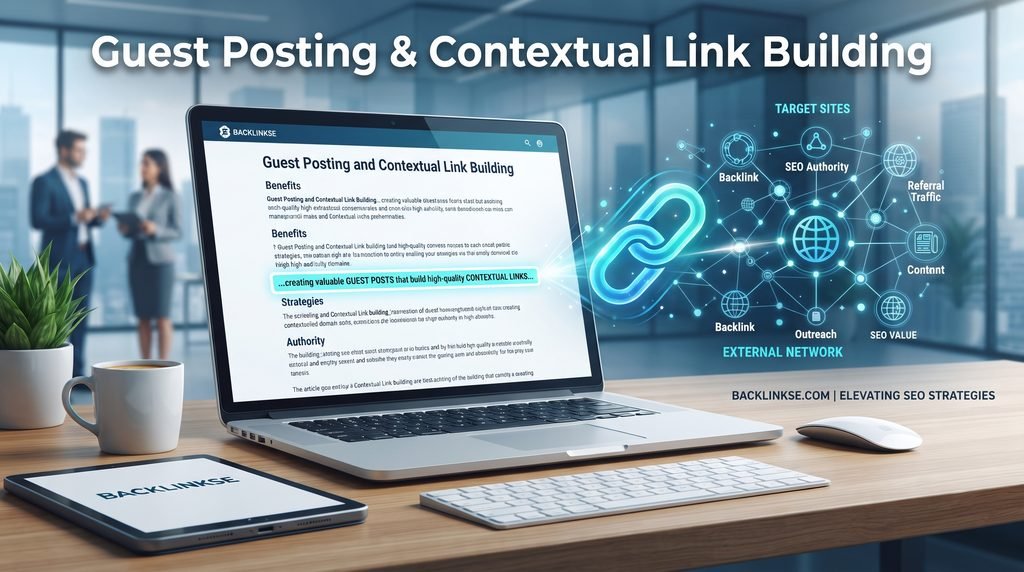
Guest posting remains one of the most common methods behind link building services, and it’s often misunderstood.
Done properly, it means writing a genuinely useful article for a relevant publication, with a link to your site where it fits the reader’s needs. The host site gets quality content. You get exposure and a contextual backlink.
Done badly, it means mass-produced articles placed on sites that exist mainly to sell links. Google has been clear for years that link schemes and manipulative practices violate its spam policies. The difference is editorial: does a real reader benefit from this article, and does the link earn its place?
Contextual link building more broadly applies the same idea. Whether the link comes through a guest post, a niche edit, or a data-driven story, it should sit naturally inside content that’s relevant to both the linking page and the destination.
White-Hat vs. Risky Link Building
White-hat link building follows search engine guidelines. It focuses on earning links through real value: useful content, genuine outreach, and relevant placements.
Risky tactics try to manufacture authority quickly. Common examples include:
- Buying links in bulk from private blog networks (PBNs)
- Automated link blasts and comment spam
- Link exchanges at scale (“you link to me, I’ll link to you”)
- Hidden or irrelevant links inserted into unrelated pages
- Sudden spikes of exact-match anchor text
Some of these can produce short-term movement. The trade-off is that they can also lead to manual actions, lost rankings, or a cleanup project that costs more than the original campaign. For any business that depends on organic traffic, that’s rarely worth it.
A fair caveat: even white-hat link building involves some judgment. Many legitimate outreach campaigns involve paid placements or sponsored content, and search engines expect those to be handled properly, for instance with appropriate link attributes where required. A trustworthy provider will be open about how their links are obtained rather than vague.
How to Evaluate a Link Building Provider
Choosing among link building services comes down to trust and transparency. These are the questions worth asking.
Do they build links manually? Ask how they find sites and who does the outreach. “Proprietary network” is a phrase to be cautious about.
Can they show the kinds of sites they place links on? You don’t need a full list before signing, but they should describe their standards clearly.
How do they judge relevance and quality? Look for answers that go beyond a single metric.
What does reporting look like? You should see live URLs, anchor text used, and the target pages supported.
Are their promises realistic? No one can guarantee a specific ranking or timeline. Be wary of anyone who does.
What happens if a link is removed? Reputable providers have a replacement or remediation policy.
Do they talk about your business, or just about links? A provider who asks about your audience, competitors, and priority pages is more likely to build something useful.
Also watch for pricing that seems too low for the work described. Genuine outreach, writing, and editorial placement take time, and the price usually reflects that.
How Link Building Supports Google and AI Search Visibility

Link building has always been about visibility in Google search, but search is changing. Google’s AI Overviews and other AI-powered answer tools now summarize information and cite sources directly in results. This has given rise to the idea of GEO, or Generative Engine Optimization: making content easy for AI systems to understand, trust, and reference.
Nobody outside these companies fully knows how AI systems weigh every signal, so it’s worth being careful here. What can be said with reasonable confidence is this:
- AI answer tools generally draw on content that’s already discoverable and credible in search.
- Being cited and linked from reliable sites helps establish your brand as a recognized entity in a subject area.
- Clear and well-structured content is easier for search engines and AI systems to extract and cite.
Actually, the same qualities—relevance, credibility, and genuine editorial positioning—that enable successful link generation also encourage increased search exposure. If a brand is regularly featured on respectable websites in its field, it will rank higher in both traditional and AI-driven search. Strong on-page content, a distinct, consistent brand presence, and links are all parts of that picture.
Common Link Building Mistakes
Even careful teams get these wrong.
- Chasing metrics over relevance. A high-authority site with no topical connection is often less useful than a smaller, focused one.
- Over-optimizing anchor text. Forcing exact-match keywords into every link looks unnatural.
- Ignoring the destination page. If the page you’re linking to is thin or hard to use, extra links won’t help it.
- Building too fast. A sudden surge of links, especially in a new site’s profile, can look artificial.
- Neglecting internal linking. Authority from backlinks spreads further when your own site links between related pages sensibly.
- Treating links as the whole strategy. –User experience, technical SEO, and content are equally important.
- Anticipating Quick Outcomes. The effects of link building vary by industry and competition and usually take weeks to months to manifest.
How to Assess the Performance of Link Buildings
Effective measurement considers results rather than just link counts.
Link-level metrics: include anchor text distribution, placement quality, number of new referring domains, and linking site relevancy.
Search metrics: changes in impressions, average position, and clicks for the pages you targeted, which you can track in Google Search Console.
Traffic metrics: You may monitor search metrics in Google Search Console, including changes in impressions, average position, and clicks for the URLs you targeted. Traffic stats include both referral traffic from the links themselves and organic visits to the supported pages
Business metrics: Business KPIs include things like leads, sign-ups, or purchases connected to organic traffic.
Be honest about what you expect. There are many reasons why rankings change, thus it might be difficult to attribute a change to a particular campaign. Analyze trends over several months and contrast results with your own and your rivals’ innovations.
Frequently Asked Questions
What do link building services include?
Typically research, strategy, outreach, content creation, link placement, and reporting. The exact mix depends on the provider and the methods used, such as guest posting, digital PR, or link insertions.
How much do link building services cost?
Prices vary widely depending on site quality, content involved, and campaign scope. Very low prices often signal automated or low-quality methods, so it’s worth asking what each link actually involves.
How long does link building take to work?
Usually weeks to several months. Search engines need time to discover and evaluate new links, and competitive topics generally take longer.
Are link building services safe?
They can be, when they follow white-hat practices: relevant sites, manual outreach, natural anchor text, and real editorial value. Services that rely on private networks or bulk automation carry more risk.
Can link building guarantee first-page rankings?
No. Any provider promising specific rankings is overpromising. Links are one factor among many.
Do backlinks help with AI search?
Indirectly, they can. Links from credible, relevant sites help build the authority and brand recognition that support visibility in both traditional search and AI-generated answers, though how each AI system weighs them isn’t publicly documented.
Should I do link building in-house or hire a service?
It depends on your time, experience, and existing relationships. In-house works when you have the capacity for consistent outreach. A service makes sense when you want experienced people and established processes without building a team.
Conclusion: Choosing Link Building Services That Last
The best link building services aren’t defined by volume. They’re defined by relevance, honesty, and patience. A smaller number of well-placed contextual links from credible sites will generally serve your search visibility better than a large batch of weak ones, and it’s far safer over time.
At Backlinkse, our approach is built around white-hat SEO: manual outreach, relevant placements on quality websites, thoughtful anchor text, and transparent reporting so you can see exactly what was built and where. The aim is sustainable growth in Google search and in AI-driven discovery, not quick spikes that fade.
If you’re weighing your options, start by reviewing your current backlink profile and priority pages. When you’re ready to talk through a strategy, Book a call is a good place to begin